

Best Hair Extensions for Fine or Thin Hair: A Professional Guide
For someone with fine or thin hair, the goal is rarely just “more hair.” It is believable fullness without visible attachments, unnecessary weight, or a result the natural hair cannot responsibly support. That makes the question more specific than choosing the most popular extension method.
There is no single best hair extension method for every person with fine or thin hair. The right choice depends on strand diameter, natural density, scalp and hair condition, the location of low-density areas, the amount of added hair, attachment placement and the client's ability to maintain the service. Smaller bonds or thinner seams can create more planning flexibility, but professional assessment is what determines whether any method is appropriate.
For some clients, individual keratin bonds may provide the right strand-level control. For others, a carefully planned weft service may create the needed fullness. A temporary hairpiece, topper, medical evaluation or no extension service may be the better recommendation in other cases.
Fine Hair, Thin Hair and Thinning Hair Are Not the Same
These terms are often used interchangeably in everyday conversation, but they describe different starting conditions. Research evaluating hair amount treats hair diameter and hair density as separate characteristics, and both can affect how full the hair appears. That distinction matters before an attachment plan is considered. Read the published research on hair density and diameter.
| Term | What it describes | Why it changes the extension plan |
|---|---|---|
| Fine hair | The diameter of each individual strand | Section size, attachment weight, visibility and handling must respect the characteristics of the natural strands |
| Thin or low-density hair | How much natural hair is present and how it is distributed | Density affects support, concealment, total added hair and where attachments may be appropriate |
| Thinning hair | A reduction or change from the client's previous density | New or progressive change may indicate active shedding or another concern that should be medically assessed before an extension service |
| Compromised hair | Hair weakened by breakage, chemical processing, heat or another stressor | Current integrity may limit or rule out a semi-permanent service regardless of the attachment method |
A person can have fine strands and high density, coarse strands and low density, or fine strands with low density. Someone who has always had that hair is also different from a client noticing a new change.
The first question is not “K-tips or wefts?” It is “What is the starting condition, and what can this hair responsibly support and conceal?”

Can People With Fine or Thin Hair Wear Extensions?
Often, yes. Fine or low-density hair does not automatically exclude someone from extensions, but it makes an in-person consultation essential.
A professional should assess the natural hair in the proposed attachment areas, not only the overall hairstyle. The plan may need to prioritize subtle volume over dramatic length and density.
A small bond does not make every section appropriate, and a thin seam does not make every row appropriate. Construction creates options; it cannot override density, condition, concealment or total weight.
New or unexplained shedding, progressive thinning, significant breakage, scalp pain, inflammation or irritation should pause the service. A stylist should not diagnose the cause behind the chair. The American Academy of Dermatology recommends seeing a board-certified dermatologist to determine the cause of hair loss before deciding what should happen next.
If you are considering hair extensions for thin hair, find a Vera Artist for a personalized professional recommendation rather than selecting a method from photos alone.
What Determines the Best Extension Method for Fine or Thin Hair?
The best type of hair extensions for fine hair is the one selected through a complete consultation. A professional should evaluate these factors together.
1. Strand diameter and strength
The stylist must consider how fine strands behave and the relationship between each natural-hair section and the attachment it will support.
2. Density and distribution
Density can vary by area. The plan must reflect the support and concealment actually available in each proposed attachment zone.
3. Scalp and hair condition
Scalp comfort, chemical history, breakage and reported shedding all matter. Irritated, inflamed or compromised hair may not be ready for a semi-permanent service.
4. Location of the concern
Low density at the sides, nape, perimeter, part or crown does not create one universal problem. Conventional extensions are not always the right format for top-of-head coverage.
5. The desired result
Modest volume is a different plan from dramatic length and density. The result must be achievable without an unsuitable amount of added hair.
6. Attachment footprint and concealment
Individual bonds, weft rows, tape panels, clips, halo wires and hairpieces create different footprints. The attachment must fit the available support and remain concealable.
7. Total weight and distribution
One bond, weft or panel tells only part of the story. The complete amount, supporting hair and distribution all matter.
8. Maintenance behavior
The client's willingness to brush, wash, dry, protect and return for maintenance or removal should shape the recommendation before installation.
This is not a checklist a client can use to prescribe their own method. It is the framework a trained professional should use to make an individual recommendation.
Comparing Types of Hair Extensions for Fine or Thin Hair
Search results often rank methods by safety. A category name does not reveal total weight, attachment size, distribution, technique, maintenance or the client's starting condition.
| Method | Planning advantage | Important limitation |
| Individual keratin bonds or K-tips | Strand-level placement lets a professional vary the amount and distribution of extension hair in detailed areas | Every bond still requires a suitable natural-hair section, controlled weight, professional application, care and removal |
| Weft extensions | A row-based format can distribute extension hair across a planned foundation and build broader areas of density | Total grams, seam profile, stacking, foundation, row placement and concealment must match the client |
| Tape-in extensions | The panel creates a wider attachment footprint | Adhesive, visibility, natural hair between tabs, maintenance and removal must all be assessed; Vera does not offer tape-ins |
| Clip-in extensions | Temporary and removable for occasional wear | Clips concentrate pressure at specific points, and a set may be too heavy or visible for some low-density areas |
| Halo extensions | A temporary format without bonded or sewn attachments | The client still needs enough natural hair in the right places to conceal the wire and blend the added hair |
| Toppers or hairpieces | Designed specifically to add coverage at the top, part or crown | This is a separate product category with its own fitting and attachment considerations; a specialist assessment may be more useful than conventional extensions |
No row in this table is a universal winner. A professionally selected and maintained method may be appropriate for one client and inappropriate for another with superficially similar hair.
K-Tip Extensions Versus Wefts for Fine or Low-Density Hair
K-tip and weft extensions can both create fullness and length, but they give the professional control at different scales.
| Decision factor | Individual keratin-bond format | Weft format |
| Placement unit | One individual attachment | A continuous seam placed within a planned row |
| Density control | Adjusted through the number and distribution of individual bonds | Adjusted through weft selection, cutting, stacking, row placement and foundation planning |
| Placement pattern | Allows granular, strand-level planning where the natural hair can support and conceal a bond | Creates row-level density across broader planned zones |
| Total-weight plan | Determined by the number, weight and distribution of bonds | Determined by grams, number of wefts, stacking and distribution across rows |
| Salon follow-up | Requires method-specific home care and professional removal | Requires method-specific home care, reassessment and move-ups or reinstallation where appropriate |
| Suitable client | Determined through individual assessment | Determined through the same individual assessment; neither format is universally best |
This is an architectural comparison, not a declaration that one method is safer. For more depth, read Vera's professional guide to K-tip hair extensions or professional guide to weft hair extensions.

Why Weight and Distribution Matter More Than “Lightweight” Marketing
“Lightweight hair extensions for thin hair” is a useful search phrase but an incomplete product standard. The number on one strand or weft must be considered within the finished installation.
A 0.4-gram bond is a defined starting unit. The total service still depends on how many bonds are used, how each one is matched to the natural-hair section and where the attachments are distributed. A thin weft seam may reduce bulk at the seam, but the plan still includes the grams placed in each row, the foundation supporting them and the number of rows or stacked wefts used.
The intended result matters too. A conservative volume service may require less added hair than a dramatic transformation, but there is no universal gram range that applies to every fine- or low-density client.
Transparent specifications help a professional calculate. They do not make the suitability decision for them. For the complete planning framework behind those variables, read our hair extension weight and density guide, including grams, natural-hair support, desired result and installed distribution.
When Hair Extensions May Not Be the Right Solution
Sometimes the right recommendation is to pause, modify or decline the service.
That may be appropriate when a client presents with:
-
New, unexplained, patchy, progressive or dramatic hair loss.
-
Active excessive shedding.
-
Scalp pain, inflammation, sores, crusting or persistent irritation.
-
Significant breakage or hair too compromised to support the proposed attachment plan.
-
Insufficient density or concealment in the desired attachment area.
-
A part or crown concern that may be better served by a topper, hairpiece or medical evaluation.
-
A desired result that requires more length or density than the professional believes the natural hair should support.
-
An inability or unwillingness to follow the required care and professional-removal schedule.
Extensions do not treat hair loss or restore growth. When thinning is a change from baseline, a board-certified dermatologist should identify the cause before the extension conversation resumes.
What Are the Least Damaging Hair Extensions for Fine Hair?
No semi-permanent method is universally damage-free or “least damaging.” Risk changes with candidate selection, attachment size, section-to-weight matching, placement, tension, total weight, care, maintenance and removal.
Repeated pulling can contribute to traction alopecia. The American Academy of Dermatology identifies extensions and weaves among styles that can create repeated stress and lists pain, stinging and scalp crusting as warning signs. A peer-reviewed review of traction alopecia also describes the relationship between prolonged pulling and hair loss.
A responsible extension professional should:
-
Match the attachment and added hair to an appropriate natural-hair section or foundation.
-
Avoid using a small bond or thin seam as permission to overload the natural hair.
-
Treat pain, persistent tightness, stinging, irritation or unusual shedding as a reason to reassess promptly.
-
Adjust the goal, reduce the amount of added hair or decline the service when the starting condition does not support the plan.
-
Include maintenance and professional removal in the service from the beginning.
The better question is not “Which method can never cause damage?” It is “Which plan is appropriate for this client, and how will the natural hair be monitored throughout the complete wear cycle?”
What Professionals Should Evaluate in an Extension Line
For fine or thin hair, professionals need specifications and support, not product adjectives.
-
Transparent unit and pack weights: Grams per bond, weft, piece and pack support ordering and density planning.
-
Attachment dimensions and consistency: Measurements reveal the real footprint behind terms such as “micro” or “ultra-thin.”
-
Customization options: The professional should be able to vary total hair and attachment pattern.
-
Seam or bond behavior: Confirm cutability, flexibility, workability and the approved protocol.
-
Hair quality: Evaluate human and Remy status, cuticle handling, synthetic content, coatings and consistency.
-
Color accuracy and dimensional range: A close match can reduce unnecessary correction and visual bulk.
-
Length and texture options: Availability should support a realistic result rather than force the plan.
-
Education, care and removal support: Installation, home care, compatible tools, maintenance and removal belong to the system.
-
Account and fulfillment support: Reliable product access matters when a client returns.
These criteria connect a sound consultation to a product the professional can plan around consistently.

How Vera Supports Two Different Attachment Plans
Vera gives approved professionals two product architectures within one color and hair-quality system. Neither is a universal answer; each offers a different way to build a plan after assessment.
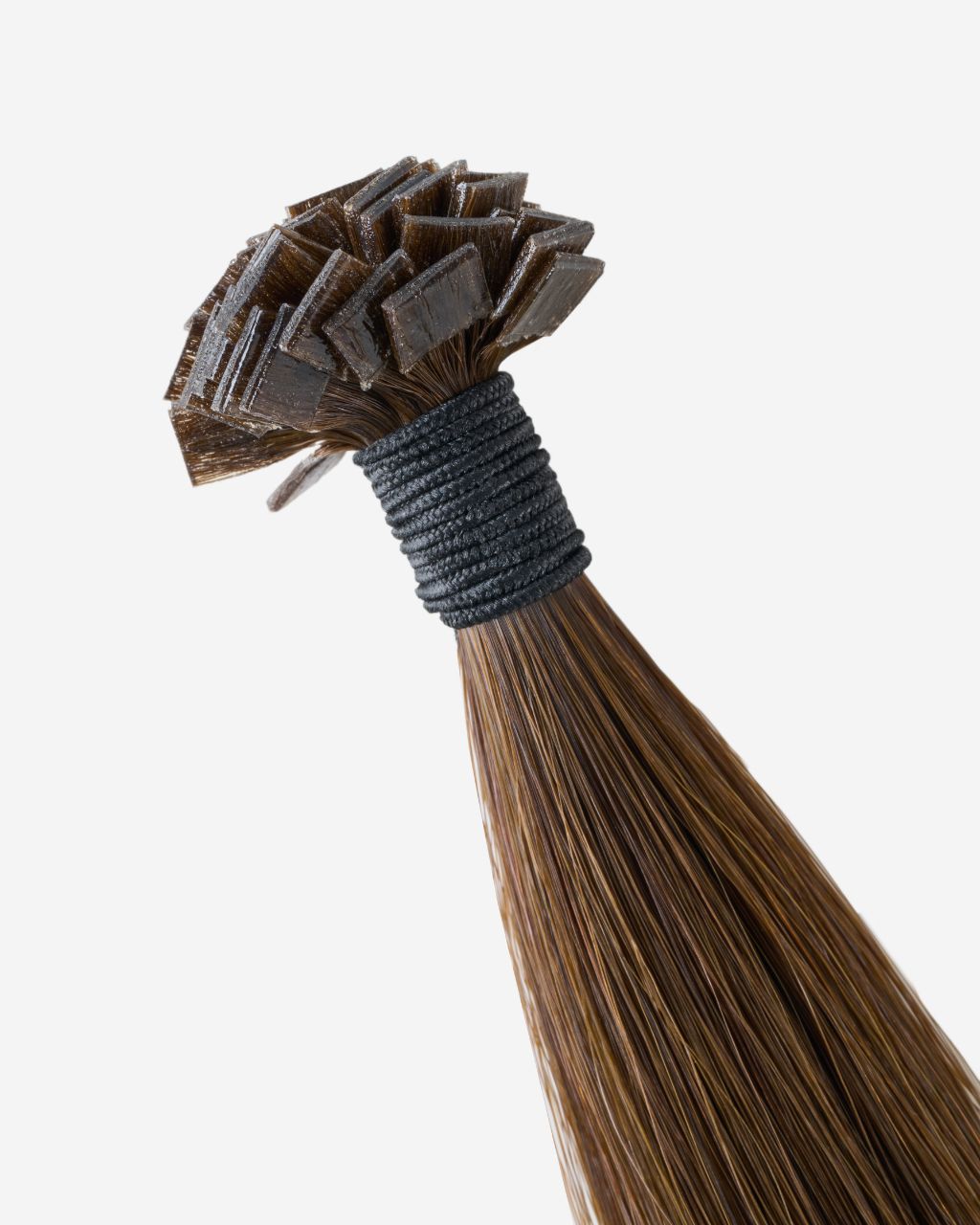
Vera Keratin Micro-Bonds™
Vera Keratin Micro-Bonds™ are individual 0.4-gram strands made with pre-formed organic Italian keratin bonds. Each pack contains 50 bonds and 20 grams of extension hair. Every bond measures 5 millimeters wide by 7 millimeters tall.
The compact format mimics the smaller bonds professionals often create behind the chair, with a consistent weight and shape ready to apply directly from the pack under Vera's protocol.
The format supports strand-level control when a professional determines the natural hair can support and conceal the planned bonds. Specifications do not determine candidacy.
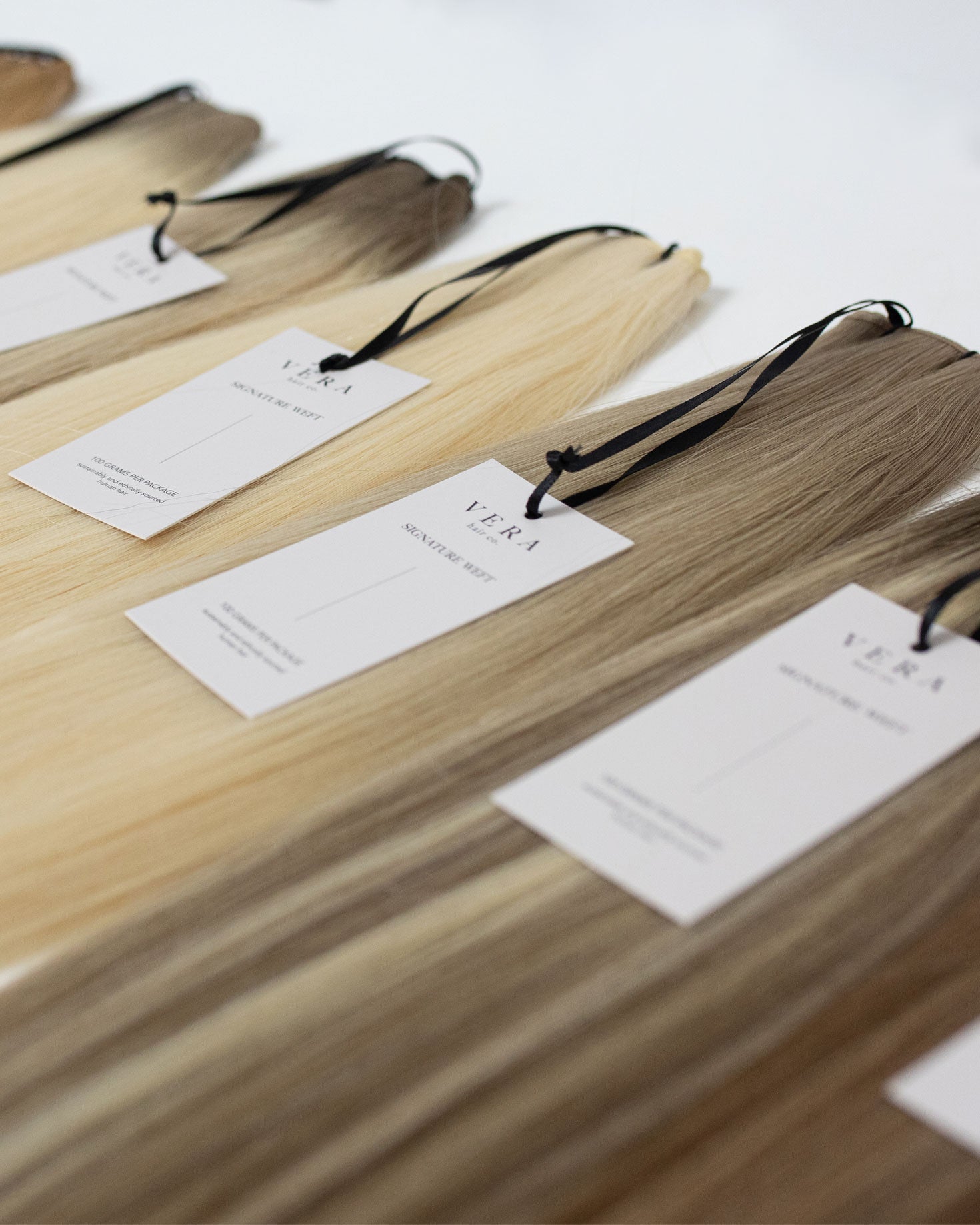
Vera Micro-Tied Wefts
Vera Micro-Tied Wefts use a thin, flexible polyurethane seam designed to be cut where needed under Vera's protocol without unraveling. The construction is free from short return or “mustache” hair and gives the stylist a customizable starting point for row-level planning.
Each pack contains two wefts. The 18-inch pack contains two 20-gram wefts, for 40 grams total. The 22-inch pack contains two 25-gram wefts, for 50 grams total.
The format supports row-level planning when it fits the client's density, goal, foundation and concealment needs. A thinner seam does not make every row or density goal appropriate.
One professional color and hair system
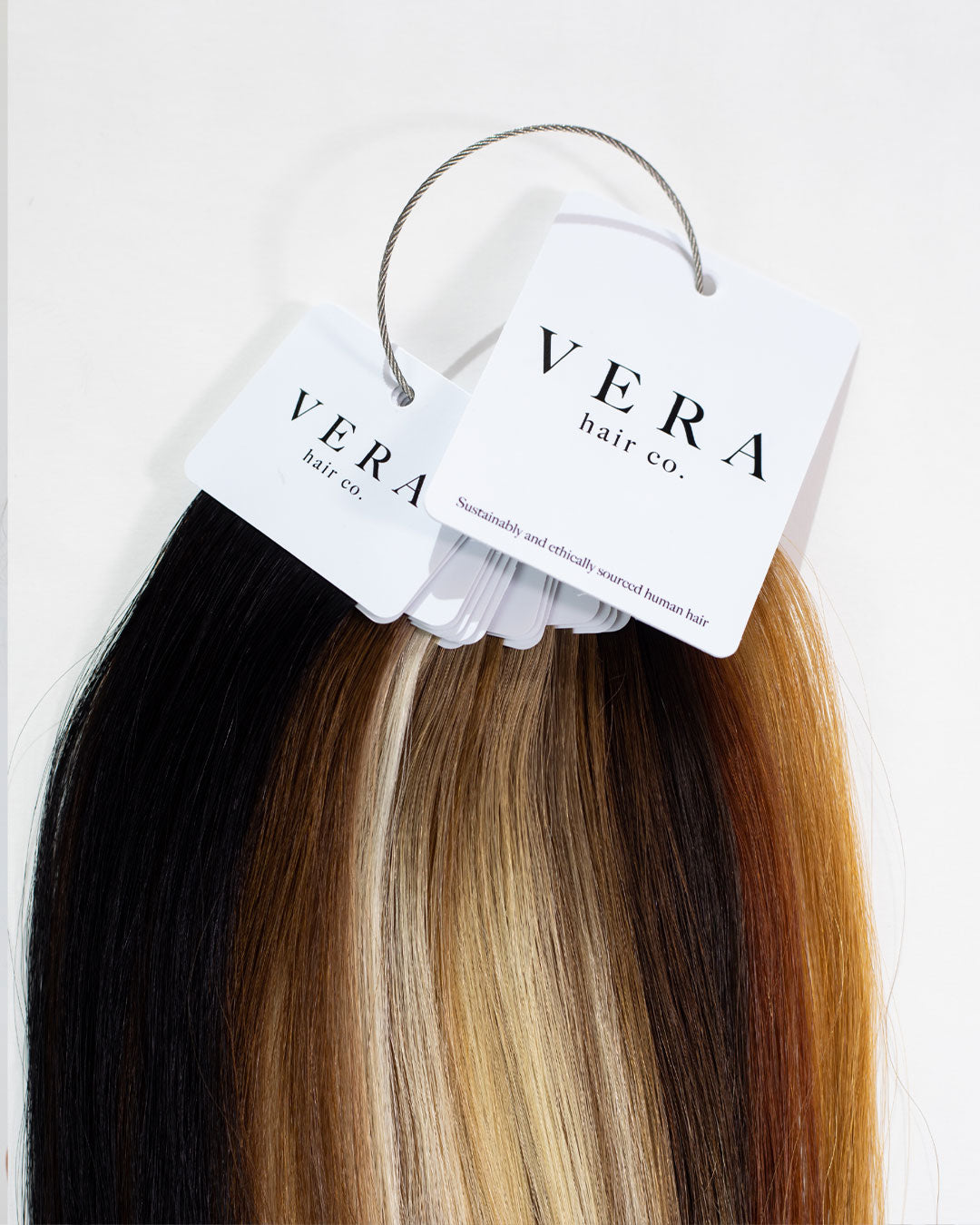
Both formats use 100% human Remy hair and Vera's custom-developed Signature Shades. Solid and dimensional colors work within either architecture, while transparent pack specifications support ordering and planning.
Vera also provides professional care and product-specification materials through its Digital Resource Library, along with account support, rewards and app ordering for approved professionals.
Product specifications help a professional plan. The consultation determines whether the plan should proceed.
Explore Keratin Micro-Bonds™
Explore Micro-Tied Wefts
Apply for Professional Access
Fine-Hair Extension Maintenance Begins With the Installation Plan
Good maintenance cannot correct an unsuitable installation. It should be planned before the service and tailored to the attachment method, the client's natural hair and the product system.
Clients should follow the installing professional's exact instructions, including how to:
-
Brush and detangle gently while supporting the attachment areas as directed.
-
Keep the scalp and attachments clean, then dry the hair thoroughly after washing.
-
Keep incompatible products away from bonds, seams, beads or adhesive areas.
-
Protect the hair during sleep, swimming and heat styling.
-
Return for reassessment, move-ups or professional removal on the stylist's schedule.
-
Report pain, persistent tightness, irritation, unusual shedding or visible breakage promptly.
Vera's current professional extension care resources include home-care, swimming-care and product-weight guides. The professional who installed the hair should remain the client's primary source for method-specific guidance.
Frequently Asked Questions
What is the best type of hair extension for fine hair?
There is no universal best type. Individual bonds offer strand-level placement; wefts provide row-level density; other methods suit different goals. Selection depends on strength, density, condition, concealment, desired result, weight and maintenance.
Are K-tip extensions suitable for thin hair?
They can be for some clients. The format gives a stylist detailed control, but each bond still needs suitable natural hair for support and concealment. Read the professional K-tip extension guide.
Are weft extensions suitable for fine hair?
Sometimes. Suitability depends on density, strength, construction, total grams, foundation, placement, concealment and maintenance. A thin seam does not make every plan appropriate. Read the professional weft extension guide.
What are the least damaging hair extensions for thin hair?
No method is universally least damaging. Client selection, weight, tension, technique, care, maintenance and removal all affect risk. Pain, tightness or irritation should prompt reassessment.
Can hair extensions be used when hair is thinning at the crown or part?
Conventional extensions do not solve every crown or part concern. A topper or hairpiece may be more relevant for some patterns. New or progressive thinning should be assessed by a board-certified dermatologist first.
Can extensions add volume without adding much length?
Yes. An extension plan can prioritize fullness, perimeter density or support for a haircut rather than dramatic length. The amount and placement should still be determined from the natural hair and the result it can responsibly support.
How much extension hair should be used on fine hair?
There is no universal gram recommendation. The appropriate amount depends on natural density, strand strength, attachment method, distribution, desired length, haircut, head size and the professional's plan. Transparent product weights help the stylist calculate, but they do not replace individual assessment.
Can hair extensions make thinning worse?
Extensions that place repeated or excessive stress on the hair can contribute to breakage or traction alopecia. Risk is not determined by the method name alone. If thinning is active or unexplained, pause the service and seek medical assessment; if extensions are installed, the natural hair should be monitored throughout wear and professional removal.
The Best Method Begins With the Right Assessment
The best hair extensions for fine hair and the best hair extensions for thin hair are not selected from a universal ranking. They are chosen by first understanding whether the client has fine strands, low density, active thinning, compromised hair or some combination of those conditions.
From there, a qualified professional can decide whether an individual-bond method, a row-based weft plan, another category or no extension service is the responsible path. The desired result, attachment areas, total weight, concealment and maintenance capacity all belong in that decision.
Considering extensions for yourself? Find a Vera Artist to receive a private, personalized recommendation for a Vera professional near you.
For licensed extension professionals, explore Vera Keratin Micro-Bonds™, Vera Micro-Tied Wefts, or apply for professional access.