



How to Choose a Hair Extension Supplier: A Stylist’s Guide
Choosing a hair extension supplier affects far more than the product delivered in a pack. The decision can influence consultation accuracy, installation planning, client results, inventory exposure and the amount of unpaid time a salon spends correcting avoidable problems.
Quick answer: Choose a supplier by evaluating the complete system, not one attractive sample. Verify:
- Hair and processing standards.
- Exact pack and attachment specifications.
- Shade and texture consistency.
- Method-specific construction.
- Inventory and fulfillment reliability.
- Written return and defect policies.
- Professional support and education.
- Total cost per completed service.
Test representative products under controlled conditions and place a repeat order before assuming one sample reflects ongoing quality.
The right supplier is the one whose products and operations consistently fit your salon—not simply the one with the lowest pack price or the strongest marketing language.
What Makes a Hair Extension Supplier Professional?
A professional supplier can support trained service providers with clear technical specifications, repeatable products, reliable ordering, useful education, service support and accountable written policies. Some suppliers use licensed-only accounts, while others also serve retail customers. The access model alone does not establish product quality or professional reliability.
The words supplier, brand, distributor and manufacturer are often used interchangeably, but they do not describe exactly the same role:
| Business type | Primary role | What a stylist still needs to verify |
|---|---|---|
| Manufacturer | Produces some or all of the hair or finished extension product | Finished-product quality control, consistency, support, policies and accountability |
| Distributor | Purchases and resells products made by another company | Who controls specifications, how defects are resolved and whether products can be reordered consistently |
| Extension brand or supplier | Provides a finished product system to professionals | Hair standards, construction, inventory, education, support and the evidence behind its claims |
| Private-label supplier | Produces or sources products sold under another company's name | Customization, minimums, testing, ownership of specifications and ongoing batch control |
One model is not automatically better than another. Buying directly from a factory does not guarantee better hair, and working with a branded supplier does not guarantee consistent service. The important question is who defines the finished specifications, checks them and accepts responsibility when the delivered product does not match them.
Define What Your Salon Needs Before Comparing Suppliers
Begin with your service model. A large catalog can look impressive while adding little value if most of it does not match your clients or the methods you perform.
Document three categories before opening supplier applications or comparing price lists.
Your services
- The extension methods you are trained and prepared to offer.
- Whether most appointments add targeted density, full length or corrective volume.
- The lengths, weights and attachment formats used most often.
- Whether the salon stocks hair or orders specifically for each client.
Your clients
- The shade families and levels requested most often.
- The natural textures you regularly need to match.
- The density, lifestyle and maintenance patterns common within your clientele.
- The amount clients realistically invest in hair, installation and maintenance.
Your operating requirements
- The fulfillment window needed between consultation and installation.
- The amount of inventory the salon can carry responsibly.
- The technical and color-matching support the team actually uses.
- The written return, defect and problem-resolution terms the business requires.
Separate each requirement into must have, preferred or not important to our model. This keeps a long product menu, a large discount or an attractive launch offer from outweighing the criteria that determine whether the relationship will work after the first order.
1. Evaluate the Hair Beyond the Marketing Label
Terms such as Remy, single donor, virgin and double drawn describe different characteristics. They are not interchangeable, and no single term establishes the quality of the finished extension product.
At minimum, ask the supplier to explain:
- Whether the product is entirely human hair or contains synthetic fiber.
- Whether the cuticle is retained and kept in a consistent root-to-tip direction.
- What the supplier means by single donor, multi-donor, single drawn and double drawn.
- Where the hair is sourced and what the supplier can substantiate about collection.
- Which coloring, lightening, texture-setting, acid processing or surface coatings are used.
- Which additional color, heat and care services are permitted.
Remy describes preserved strand orientation. It does not prove that the hair is unprocessed, single donor, dense through the ends or consistent across orders. Our guide to what Remy hair means explains those distinctions in detail.
The supplier should be able to define its language without relying on a proprietary grade such as 10A, 12A or “luxury.” Grades are difficult to compare when each company controls its own scale. Exact specifications and repeatable performance are more useful than an impressive label.
2. Compare Exact Product Specifications
Pack price is not meaningful until you know what is inside the pack. Compare like with like.
For each product, verify the applicable specifications:
- Total grams of hair per pack.
- Number of wefts, bonds, tapes or strands.
- Weight per weft, bond or strand.
- Available lengths and the way length is measured.
- Usable weft width or attachment dimensions.
- Density through the mid-lengths and ends.
- Seam, bond, tape or tip construction.
- Whether the product can be cut or customized and under what limitations.
- Texture, finish and expected behavior after washing.
Two packs with the same price may deliver different amounts of usable hair. Two products labeled as the same method may also differ at the attachment, where thickness, flexibility, return hair, bond size and customization rules affect planning behind the chair.
Use the supplier's published numbers to compare cost per gram and the amount required for a typical result. Then confirm the product in hand matches those specifications. Vera's hair extension weight and density guide explains why grams, distribution and finished density must be evaluated together.

3. Inspect Method-Specific Construction
Hair-fiber quality and attachment quality are separate decisions. High-quality hair can still be delivered in a format that does not work for your method, placement or client base.
When evaluating wefts
Review seam thickness, flexibility, width, return hair and the manufacturer's rules for cutting. Determine how the weft stacks and whether its actual construction supports the way your salon builds rows. Do not assume that every product called a genius, hand-tied or machine weft shares the same construction. Our genius-weft comparison shows the specifications that distinguish those formats.
When evaluating individual keratin bonds
Review the grams per bond, consistency of bond size, keratin specification, application behavior and the supplier's removal protocol. A smaller bond is not automatically appropriate for every placement, and a pre-formed bond should not be judged only by how discreet it looks before installation. The K-Tip hair extensions guide covers the professional planning factors in greater depth.
Ask for limitations as readily as benefits. A supplier that clearly explains where a product is not appropriate gives the professional more useful information than one claiming that a single format works for every client.
4. Test Shade and Texture Consistency
A strong shade range should make consultations more predictable, not merely look comprehensive online.
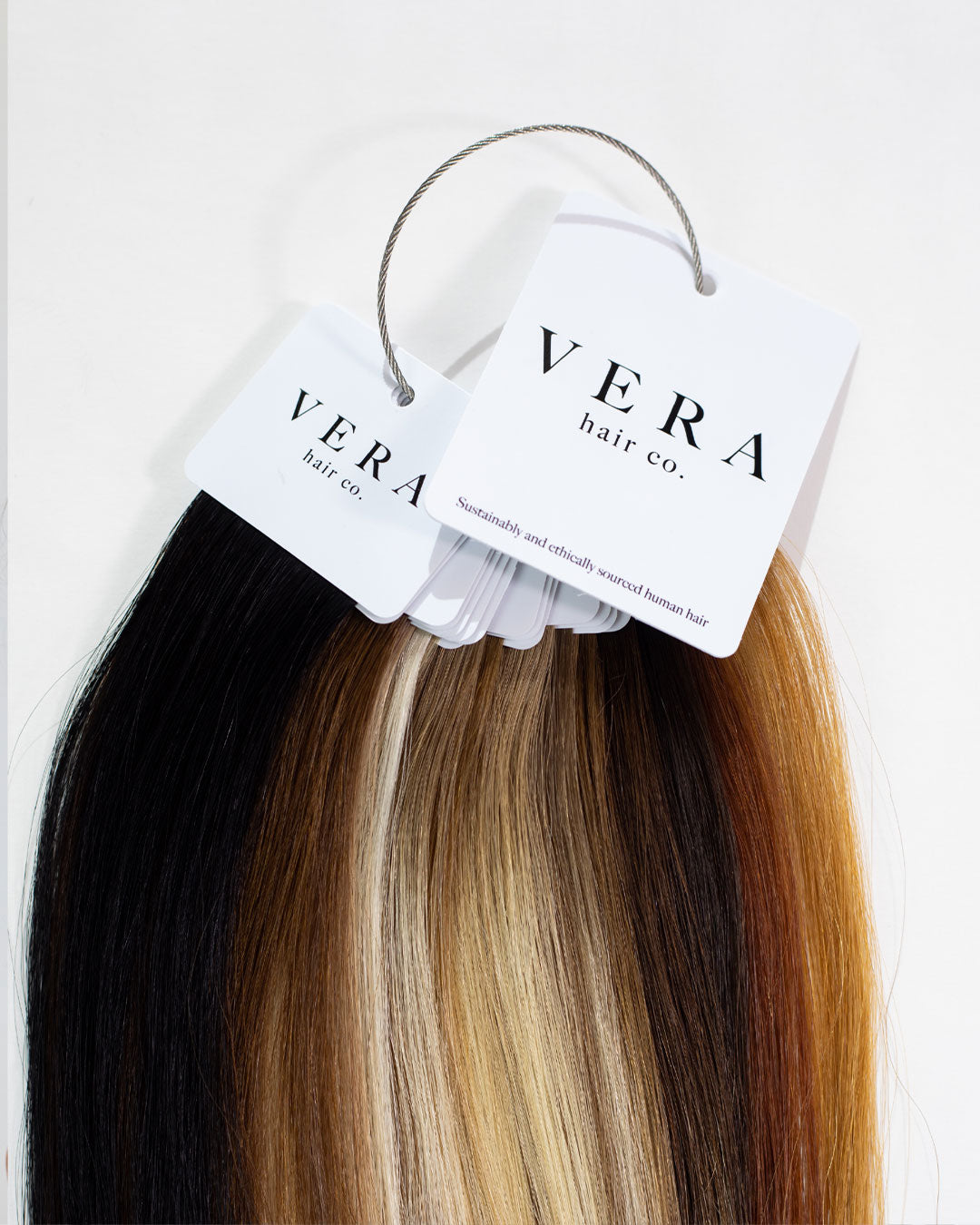
Use a current physical color ring where available, then compare it with sellable hair in indirect natural light and salon lighting. Evaluate the root, mid-lengths and ends. With rooted or dimensional colors, review the placement and proportion of each tone rather than matching only the lightest visible strand.
Ask:
- Does the sellable hair correspond closely with the current color ring?
- Are rooted and dimensional patterns positioned consistently?
- Can shades be combined as a system without requiring extensive correction?
- How does the supplier handle reasonable batch variation?
- Are lot or batch details available when a concern arises?
Texture should be assessed after following the supplier's washing and drying instructions. Factory styling can change after the first wash. Determine whether the straight, wave or curl pattern remains useful for the clients you intend to serve and whether its care requirements have been communicated accurately.
Color and texture consistency should be evaluated over more than one pack and, when possible, more than one order. A strong sample proves that the supplier can produce one strong sample. A repeat order begins to show whether the business can deliver a repeatable system.

5. Evaluate Quality Control and Problem Resolution
No supplier relationship should be evaluated on the assumption that a problem will never occur. The better question is what happens when the hair, color, construction or shipment does not match the published standard.
Before installing the first order, read the written policies and confirm:
- The return window and the condition required for a return.
- Whether exchanges are permitted.
- How opened, altered, colored or installed hair is handled.
- How a suspected defect should be documented.
- Whether the supplier requests photos, packaging, lot details or returned product.
- Who reviews the claim and how the remedy is determined.
- Whether return freight, replacement freight or account credit may apply.
A strict policy is not necessarily a poor policy. Hair that has been opened, customized or installed cannot always be returned through a normal retail process. The concern is ambiguity: the stylist should understand the rules before the product becomes part of a client service.
Track concerns by product, shade, length, order date and lot information when available. One isolated issue and a repeated pattern are different business signals. Documentation helps both the salon and supplier distinguish them.
6. Assess Inventory and Fulfillment Reliability
The best-performing product cannot support a scheduled service if the required shade, length or method is unavailable.
Review the supplier's operating system as carefully as the hair:
- Visibility into current stock.
- Reliability of core shades and lengths.
- Published order-processing and shipping cutoffs.
- Expedited options and their actual limitations.
- Backorder and preorder communication.
- Restock estimates.
- Order accuracy and tracking.
- Support when a required item is unavailable.
Do not evaluate fulfillment only during a quiet trial order. Consider what happens when a consultation converts quickly, a shipment is delayed or one shade required for a dimensional blend is out of stock.
If your salon carries inventory, determine how much cash must be committed to maintain useful coverage. If you order per client, determine whether the supplier's normal fulfillment window leaves enough time to inspect the product before the appointment.
7. Review Professional Support and Education
Education can improve product use, but the existence of a class or certification does not prove the quality of the hair. Evaluate the substance of the support.
A useful professional system may include:
- Accurate ordering and pack-planning resources.
- Current color tools and shade-matching help.
- Product-specific installation and removal guidance.
- Care information that can be shared with clients.
- Access to a knowledgeable person when an order or technical question arises.
- Clear boundaries between education, product guidance and services requiring separate method training.
Ask a technical question before committing to a large order. The quality of the answer is evidence. A useful response should address the product and its limitations directly rather than redirecting every question into a sales conversation.
8. Compare Total Service Economics, Not Only Pack Price
The lowest pack price does not always create the most profitable service. Normalize pricing first, then account for how the product affects the complete appointment.
At minimum, compare:
- Cost per gram or usable attachment.
- Hair required for the result your salon normally delivers.
- Shipping and rush-shipping expense.
- Minimums, opening orders or inventory commitments.
- Discounts, credits and rewards that can realistically be used.
- Extra customization required before installation.
- Corrective labor, replacement hair or client refunds associated with documented problems.
- Appointment capacity lost to backorders or order errors.
A simple working calculation is:
True product cost per completed service = hair + shipping + required pre-install customization + documented corrective cost
Keep product margin and service profitability separate. A salon may maintain a strong markup on hair while losing profit through extra toning, additional packs, unpaid correction or emergency freight. Use actual results from the trial rather than assigning an unsupported lifetime value to a new supplier.
How to Test a Hair Extension Supplier Before Switching
Do not move the entire service menu or purchase a large shade inventory based on one polished sample. Use a staged salon trial.
Step 1: Review the written system
Collect the product specifications, color tools, care guidance, shipping terms, return rules and defect process. Resolve contradictions before ordering.
Step 2: Choose representative products
Test the products that expose the supplier's range rather than selecting only the easiest shade. A useful group may include a common brunette, a light blonde, a rooted or dimensional shade and each texture or attachment format you genuinely intend to offer.
Step 3: Document the starting point
Record the product name, shade, length, weight, order date and lot or batch information when provided. Photograph the hair in consistent lighting and compare the delivered construction with the published specification.
Step 4: Test normal professional handling
Follow the supplier's instructions for washing, drying, detangling, heat and permitted color services. Observe manageability when wet and dry, shedding, tangling, color movement, texture behavior, end density and attachment integrity. An off-head test cannot reproduce every condition of wear, but it can expose issues that should be resolved before a client installation.
Step 5: Use a limited rollout
If the product passes the initial review, introduce it through a small number of appropriate services performed by a qualified professional. Keep client selection, home-care compliance and installation variables in the record so product performance is not judged without context.
Step 6: Place a repeat order
Compare the next order with the first. Supplier quality includes the ability to reproduce acceptable hair, color, construction and service—not simply the ability to make a strong introduction.
A Professional Hair Extension Supplier Checklist
Use the same criteria for every supplier. Mark each area meets requirement, partially meets, does not meet or not applicable. Your salon should decide which failures are hard stops before reviewing prices or promotions.
Copy or print the table and use the final column to record meets requirement, partially meets, does not meet or not applicable, followed by the evidence supporting the decision.
| Evaluation area | Questions to answer | Your status and evidence |
|---|---|---|
| Hair standard | Are material, cuticle, donor, processing, coating and density claims clearly defined? | — |
| Published specifications | Are grams, piece counts, dimensions, lengths and customization limits available and accurate? | — |
| Construction | Does the attachment format support the methods, placements and clients you serve? | — |
| Shade and texture | Do tools match sellable hair, and are repeat orders reasonably consistent? | — |
| Performance | Does the product remain manageable under the supplier's approved care and styling protocol? | — |
| Quality control | Can the supplier identify and investigate a product or batch concern? | — |
| Inventory and fulfillment | Are core products available with clear processing, shipping and restock communication? | — |
| Policies | Are returns, exchanges, installed-hair limitations and defect procedures written clearly? | — |
| Support and education | Can the team provide accurate product-specific help without overstating what the product can do? | — |
| Service economics | Does the total cost support the salon after shipping, customization, inventory and correction are included? | — |
Do not average away a hard stop. A competitive price cannot compensate for materially incorrect specifications, repeated unexplained inconsistency, unsafe guidance or the absence of a workable defect process.
Red Flags When Comparing Hair Extension Suppliers
Pause the evaluation when you encounter:
- Claims such as premium, luxury or the best without measurable specifications.
- A proprietary hair grade presented as if it were an industry-wide standard.
- Remy, virgin, single donor and double drawn used as interchangeable terms.
- Missing pack weights, strand counts or attachment dimensions.
- Universal promises about lifespan, shedding, tangling or suitability.
- Heavy pressure to make a large opening purchase before testing.
- Color tools that repeatedly differ from sellable hair without explanation.
- Important policies available only through verbal assurances.
- Changing explanations for quality concerns.
- Product or construction changes introduced without notice.
- Education that avoids limitations or functions only as a sales presentation.
Processing, coatings, country of origin and business model should not be treated as automatic proof for or against a supplier. Lack of transparency, unreliable specifications and inconsistent finished performance are the concerns.
Should a Salon Use More Than One Extension Supplier?
There is no universal number of brands a salon should carry. One supplier can simplify color systems, education, inventory and ordering. More than one can add method coverage, shade options or an operational backup when a core product is unavailable.
The tradeoff is complexity. Every additional line creates another set of color tools, specifications, policies, care instructions and inventory decisions. Add a supplier because it fills a defined need—not simply because another professional line becomes available.
If a secondary supplier is important to business continuity, qualify it before an urgent stockout. An untested backup is not an operating plan.
How Vera Hair Co. Approaches the Supplier Standard
Vera Hair Co. is a professional-only extension brand built for licensed stylists. Vera publishes product and pack specifications, provides color and ordering resources and supports professionals through a concierge-style account experience.
Vera specifies its extension hair as 100% human Remy hair with intact, aligned cuticles, single-donor sourcing and double-drawn density. The hair does not contain a synthetic blend and is not processed through an acid bath. Vera's current product system includes:
- Micro-Tied Wefts with cut-anywhere construction, a thin flexible seam and no short return hair.
- Keratin Micro-Bonds™ with 50 pre-formed 0.4-gram bonds and 20 grams of hair per pack.
- Micro-Tied Wefts in Signature Straight and Effortless Wave textures; Keratin Micro-Bonds are currently offered in Signature Straight.
- Custom-developed solid, rooted and dimensional shades intended to work together as a color system.
- A professional resource library with color, ordering, care and product-specification tools.
- Published shipping and return terms.
Vera is a focused extension system rather than an all-method catalog. It is designed for professionals building services around Micro-Tied Wefts and individual keratin bonds. A salon that requires tape-ins, I-Tips, clip-ins or another extension category will need an additional supplier.
Those specifications allow a professional to evaluate Vera against the same criteria in this guide. They do not remove the need for method training, client assessment, strand testing, correct installation or appropriate home care.
Licensed extension professionals can review additional product, color, sourcing, ordering and support details in the Vera Hair Co. FAQs. To evaluate the line directly, apply for professional access.
Frequently Asked Questions
What makes a professional hair extension supplier reliable?
A reliable supplier provides accurate specifications, repeatable products, useful color and technical tools, dependable fulfillment, written policies and accountable support. The strongest fit is the supplier whose complete system consistently serves the salon's methods and clients. Compare candidates under the same criteria and test before moving the full business.
Is Remy hair enough to prove that extensions are high quality?
No. Remy describes consistent root-to-tip orientation and cuticle alignment. Finished quality can still vary because of donor standards, processing, coatings, density, construction, color, quality control and handling. Treat Remy as one specification within a broader evaluation.
Is buying directly from a hair manufacturer better?
Not automatically. Direct manufacturing may offer customization or pricing advantages, but the professional still needs finished-product specifications, consistent batches, quality control, fulfillment, written policies and accountable support. Evaluate the complete relationship rather than assuming the shortest supply chain is the strongest.
Does wholesale pricing mean professional quality?
No. Wholesale describes a purchasing or pricing arrangement, not a hair standard. Evaluate the product and supplier first, then compare professional pricing, minimums, discounts and total service economics.
Should a stylist choose a supplier based on price per pack or price per gram?
Cost per gram is more comparable than pack price, but it is still incomplete. Also consider density through the ends, usable construction, the amount needed for a typical service, shipping, customization, inventory and documented corrective costs.
How can a stylist test extension quality before installing it?
Begin with the written specifications and supplier-approved care instructions. Document the product, photograph it in consistent lighting and evaluate it through washing, drying, detangling, styling and any permitted strand testing. If it passes, use a limited professional rollout before making a full inventory or service transition.
What should a hair extension defect policy explain?
It should explain the claim window, eligible product condition, required documentation, review process and possible remedy. It should also state how opened, colored, altered or installed hair is handled. Read the policy before using the product in a client service.
Choose the Supplier You Can Evaluate Clearly
A professional supplier should make it possible to understand what you are buying, plan a service accurately and resolve problems through a defined process. Hair quality matters, but it operates inside a larger system of construction, color, inventory, education, policies and support.
Define your requirements, compare complete specifications, test representative products and verify the repeat order. The goal is not to find the supplier with the most claims. It is to build a product relationship your salon can use consistently and responsibly.
Licensed extension professionals interested in Vera's Micro-Tied Wefts and Keratin Micro-Bonds™ can apply for professional access. Approved professionals can explore Vera's product system or contact the Vera team for ordering support.