
Hair Extension Weight and Density: How Professionals Plan Grams and Distribution
People searching for how many grams of hair extensions they need usually want one number: 50, 100, 150 or 200 grams. Those numbers are useful for understanding how much extension hair is in a pack or installation, but they are not a universal prescription.
Hair extension weight is the amount of extension hair added, usually expressed in grams. Density describes how much natural or extension hair is present within an area. A responsible plan considers both, then determines where and how the added weight can be distributed. The right amount depends on the client's natural hair, desired result, extension length, attachment format, placement and maintenance plan—not a generic “full head” chart.
For professionals, grams are an inventory and planning measurement. They become an installation decision only after the client has been assessed.
Hair Extension Weight, Density and Distribution Are Different Measurements
The three terms are closely related, but they do not mean the same thing.
| Term | What it describes | Why it matters |
|---|---|---|
| Extension weight | The mass of the extension hair, usually listed in grams per piece, pack or complete installation | Helps the professional compare products, calculate an order and document the amount added |
| Natural-hair density | How much natural hair is present within a given area of the scalp | Affects support, concealment, placement options and whether the desired result is realistic |
| Strand diameter | The width of an individual natural-hair strand, often described as fine, medium or coarse | Fine strands and low density are different conditions and require separate assessment |
| Visual density | How full the natural hair or finished result appears through the mids, ends and perimeter | Helps define whether the service is intended for targeted fullness, length, a stronger perimeter or a larger transformation |
| Weight distribution | Where and how the total extension weight is divided across rows or individual attachment points | Determines whether grams are concentrated in a few areas or distributed through an appropriate professional plan |
A client can have fine individual strands and high density, coarse strands and low density, or different density from one area of the head to another. That is why “fine hair equals fewer grams” is not a complete planning rule.
Our guide to the best hair extensions for fine or thin hair explains the distinction between strand diameter, density and active thinning in greater depth.

How Many Grams of Hair Extensions Do You Need?
There is no responsible universal answer. Two clients can request the same length and finished look while requiring very different plans—or one may not be an appropriate candidate for the requested service at all.
A professional evaluates at least seven variables before selecting an amount.
1. Natural-hair density and strand strength
The stylist assesses how much natural hair is available in each potential placement area, the diameter and condition of those strands, and whether the hair can support the proposed attachment plan. Average density across the head is not enough; the sides, temples, crown, nape and perimeter may present differently.
2. The purpose of the service
Adding targeted fullness through the sides is a different job from extending a blunt shoulder-length cut or creating a long, high-density finish. “Volume,” “length” and “full head” are not standardized quantities. The desired result has to be translated into a specific visual and technical plan.
3. The client's starting length and haircut
A strong, blunt perimeter can require more extension hair to blend than a longer, softly layered starting point. Adding length is not only about reaching the requested endpoint; the professional has to create a believable transition from the natural haircut into the extension hair.
4. Extension length
The same total grams can produce a different visual result at 18 inches than at 22 inches because the hair is distributed through a different length. Longer does not automatically mean that a client should wear more hair. It means the professional must evaluate whether the selected amount will create the desired finish at that length without exceeding what the natural hair and placement plan can responsibly support.
5. Hair construction and end density
Two products with the same listed weight may not look identical. The distribution of shorter and longer fibers, the degree of end fullness, texture and construction can change how dense the hair appears through the mids and ends. Gram weight measures mass, not the entire visual character of the product.
6. The attachment format
A weft organizes extension hair along a continuous seam and distributes it through planned rows. Keratin bonds divide extension hair into individual attachment points. The same total grams are not installed or distributed in the same way across those formats.
For a complete explanation of the two categories, read our professional guides to weft hair extensions and K-tip hair extensions.
7. Placement, concealment and the wear cycle
The professional plans where attachments can be concealed, how the total weight will be divided, how the installation is expected to grow out and what the client can realistically maintain. A number that works on paper can still be wrong if it requires overloaded foundations, crowded attachment points or placement in areas that cannot conceal or support them.

What Do 50, 100, 150 or 200 Grams of Hair Extensions Mean?
They describe quantities of extension hair. They do not describe one standardized service.
| Listed amount | What the number tells you | What it does not tell you |
| 50 grams | The product or selected pieces contain 50 grams of extension hair | Whether it is enough for a blend, appropriate for the client or intended for a partial or complete service |
| 100 grams | The planned product total equals 100 grams | How many rows or bonds should be installed, where they should be placed or whether the natural hair can support them |
| 150 grams | The combined extension-hair total equals 150 grams | That it is the correct “full head” amount for every client of a certain density or hair type |
| 200 grams | The combined extension-hair total equals 200 grams | That more hair will automatically create a better blend or more premium result |
The phrase full head of extensions is useful in ordinary conversation, but it is not a universal technical unit. One salon may use it to describe a complete length-and-volume transformation, while another may use it for a predetermined package or attachment count. Professionals should communicate the actual method, length, piece or bond count, installed grams and intended result instead of relying on the phrase alone.
Why More Grams Do Not Automatically Create a Better Result
More extension hair can create more potential fullness, but it also creates more material to attach, conceal, blend and maintain. If the requested result appears to require more hair than the natural hair can appropriately support, the answer is not to force the gram target.
The professional may need to change the plan by:
-
Choosing a more realistic finished length.
-
Prioritizing targeted fullness instead of a dramatic transformation.
-
Adjusting the haircut or blend strategy.
-
Selecting a different attachment format.
-
Using color placement to create dimension without unnecessary mass.
-
Dividing the goal across a staged or revised service plan.
-
Declining or postponing the service when the hair or scalp should not be installed over.
The gram total should follow the assessment. The assessment should never be reverse-engineered to justify a predetermined amount.
Weight Distribution Is Created by the Installation Plan
No extension product distributes weight “evenly” by itself. Product construction determines the format the professional is working with; the installer determines whether the selected amount, natural-hair sections, foundations, attachment spacing and placement work together.
For a weft service, weight is organized along one or more rows. The stylist decides the location and shape of each foundation, how many wefts are used, how they are arranged, and how much natural hair participates in supporting the row.
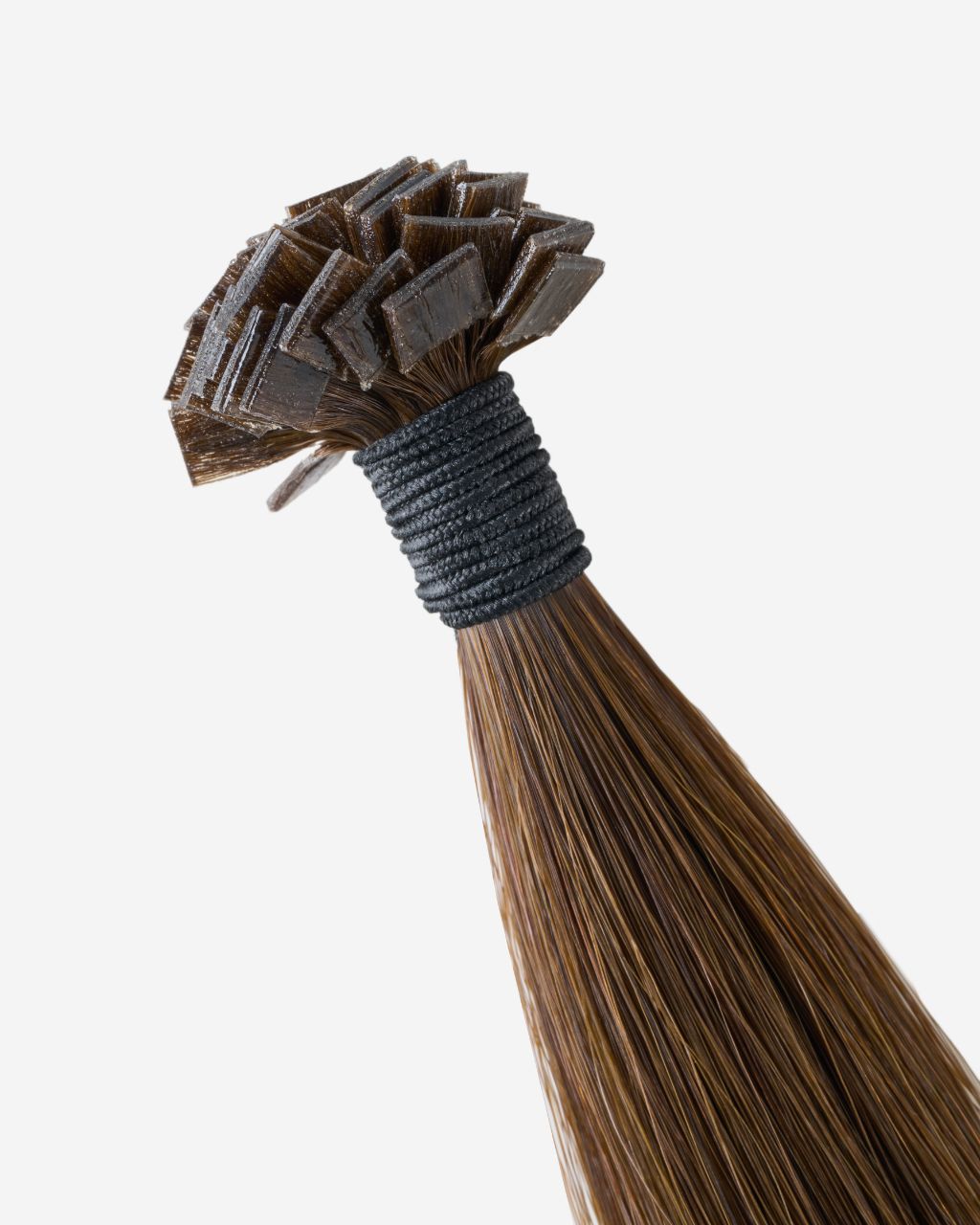
For an individual keratin-bond service, weight is divided into many smaller attachment units. The stylist decides the natural-hair section supporting each bond, the spacing between bonds, the areas included or excluded, and the total number and weight used.
| Planning question | Weft format | Individual keratin-bond format |
| Primary distribution scale | Across a continuous row or foundation | Across individual strand-by-strand attachment points |
| Product measurement | Grams per weft and pack; number of pieces | Grams per bond and pack; number of bonds |
| Placement control | Row-level shape, location, length and stacking | Bond-level location, spacing and sectioning |
| Common planning risk | Concentrating too much weight within a foundation or adding rows the natural hair cannot appropriately support or conceal | Using unsuitable sections, crowding attachments or allowing the total number of small bonds to obscure the total installed weight |
| Professional responsibility | Determine whether the row, foundation and total grams work for the client | Determine whether each bond and the complete bond map work for the client |
A thinner weft seam can reduce bulk within a row. A smaller bond can create more detailed placement options. Neither feature makes every quantity or placement suitable.
Hair Extension Pack Weight: How Vera's Specifications Translate
Transparent specifications give professionals a consistent starting point for ordering and documenting a service. Vera publishes the piece count and gram weight for both professional attachment formats.
Vera Micro-Tied Wefts
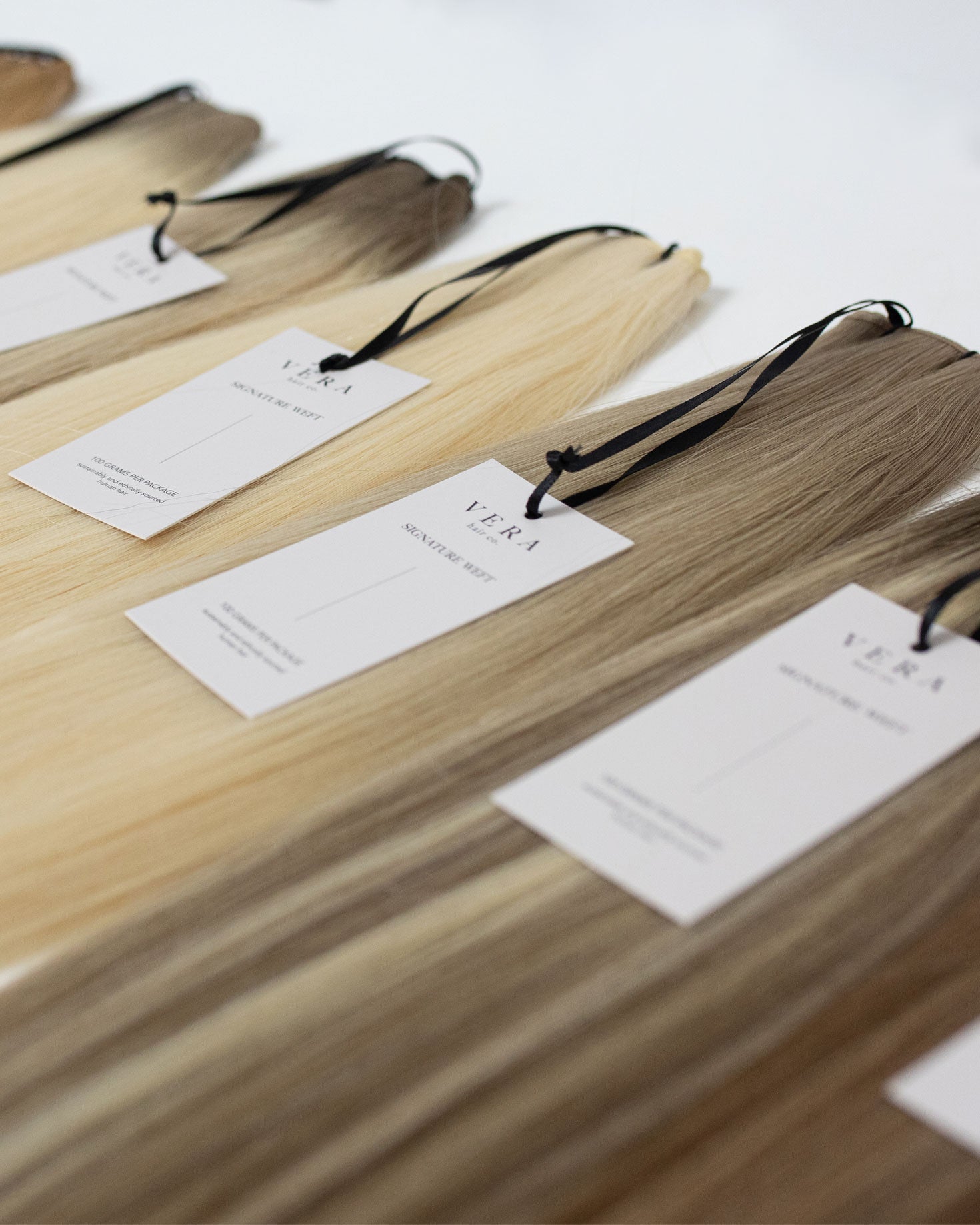
Each Vera Micro-Tied Weft pack contains two wefts:
-
An 18-inch pack contains 40 grams total: two 20-gram wefts.
-
A 22-inch pack contains 50 grams total: two 25-gram wefts.
That means three individual 18-inch wefts equal 60 grams and four equal 80 grams. Three individual 22-inch wefts equal 75 grams and four equal 100 grams.
Those calculations explain the product quantities. They are not a recommendation to install three or four wefts, a promise that one pack equals one row, or a universal formula for a client.
Vera's ultra-thin polyurethane seam is flexible, cut anywhere under Vera's product protocol, moisture resistant and free from short return or “mustache” hair. Those construction details affect how the weft can be customized and stacked; the known gram weight allows the professional to calculate the material used within that plan.
Vera Keratin Micro-Bonds™
Each Vera Keratin Micro-Bond contains 0.4 grams of extension hair. A pack contains 50 bonds and 20 grams total.
The pack math is therefore:
-
50 bonds equal 20 grams.
-
100 bonds equal 40 grams.
-
150 bonds equal 60 grams.
-
200 bonds equal 80 grams.
Again, these are quantity conversions, not installation prescriptions. A 0.4-gram bond gives the professional a consistent small-format unit for strand-level planning. Suitability still depends on the natural-hair section, bond location, spacing, total attachment map and client assessment.
How Fine Hair Changes Weight and Density Planning
Fine hair describes strand diameter. Thin or low-density hair describes how much hair is present. Active thinning or unexplained shedding may indicate a different concern entirely.
A client with fine strands may still have substantial density. A client with coarser strands may have limited density in the areas where extensions would need to be placed. The correct plan cannot be derived from one label or a chart that assigns a gram range to “fine,” “medium” or “thick” hair.
The professional has to evaluate support and concealment zone by zone, then decide whether the goal, method and weight can work together. Sometimes an individual format offers the preferred placement control. Sometimes a row-based plan is appropriate. Sometimes the responsible decision is a smaller goal or no installation.
Read Best Hair Extensions for Fine or Thin Hair for the complete suitability framework.
Can Hair Extension Weight Damage Natural Hair?
No semi-permanent extension method is universally damage-free. Risk depends on client selection, natural-hair condition, total weight, distribution, sectioning, attachment or foundation tension, installation, grow-out, maintenance and removal.
Repeated pulling can contribute to traction alopecia. The American Academy of Dermatology recommends professional application and says pain or a headache can indicate that an extension style is too tight.
“Lightweight” should therefore be treated as a measurement or comparative product description—not a safety guarantee. A small attachment can still be placed on an unsuitable natural-hair section. A thin seam can still be used within an overloaded foundation. Multiple individually light pieces can create a substantial total installed weight.
Clients should contact their extension professional promptly if they experience pain, persistent tightness, tenderness, irritation, visible pulling, matting or a significant change in shedding. Unexplained hair loss, scalp inflammation or a suspected hair or scalp condition belongs with a qualified medical professional, not a product-based diagnosis behind the chair.
Common Hair Extension Weight-Planning Mistakes
Choosing grams from a generic chart
A chart cannot assess the client's scalp, strand condition, regional density, chemical history, haircut or placement options. It can explain common product quantities, but it cannot prescribe an installation.
Treating pack weight as installed weight
The number of packs ordered and the amount actually installed may differ. Professionals should document the pieces or bonds used and the corresponding grams, particularly when a weft is cut or inventory is carried into another service.
Assuming smaller attachments eliminate total-weight concerns
Per-attachment weight matters, but so does the total number of attachments. The installation has to be evaluated as a complete system.
Adding hair to solve a blending problem
An abrupt starting haircut, unrealistic length goal or poor placement map cannot always be corrected by adding more grams. The haircut, method, length and finishing plan may need to change.
Planning only for installation day
Attachments move away from the scalp as natural hair grows. Normal shedding remains held within semi-permanent attachment areas until maintenance or removal. The professional must plan for the full wear cycle, not only the initial photograph.
Our complete hair extension maintenance guide explains at-home care, salon upkeep, warning signs and professional removal.
A Professional Weight and Density Consultation Framework
Before finalizing the product order or installation map, document:
-
Natural-hair baseline: strand diameter, regional density, scalp condition, chemical history, breakage, shedding and current length.
-
Desired result: targeted fullness, perimeter support, added length, color dimension or a combination.
-
Method and product: attachment format, hair construction, texture, length, color and published pack specifications.
-
Planned quantity: pack count, piece or bond count, total available grams and intended installed grams.
-
Distribution map: areas included and excluded, row or bond placement, concealment and the relationship between natural-hair support and added weight.
-
Finished blend: haircut and styling decisions needed to integrate the extension density with the natural hair.
-
Wear plan: home care, salon follow-up, warning signs, maintenance or removal process and conditions that would require the plan to change.
Recording the plan makes future appointments more useful. The professional can compare what was installed with how the client wore, maintained and responded to it, then adjust based on evidence rather than memory.
Vera professionals can find the Weft & Pack Weights guide, Micro-Bond Pack and Weights guide, installation resources and client-care materials in the Digital Resource Library.
Frequently Asked Questions About Hair Extension Weight and Density
How many grams of hair extensions are needed for a full head?
There is no standardized full-head amount. The professional must evaluate natural-hair density and condition, starting length, desired result, extension length, method, construction, placement and concealment before choosing the installed grams.
Is 100 grams of hair extensions enough?
It may be enough for a particular client's goal and plan, too much for another, or insufficient to create the requested blend for someone else. One hundred grams describes quantity, not suitability or outcome.
Do more grams mean thicker hair extensions?
More grams means more extension-hair mass. The visual density also depends on length, construction, end fullness, texture, placement and how the hair is blended.
Does longer extension hair require more grams?
Not by a universal rule. The same grams distributed through a longer length can create a different visual result, but the professional still cannot exceed what the client's natural hair and placement plan can appropriately support.
Are lightweight hair extensions safer for fine hair?
“Lightweight” alone does not establish safety or suitability. The stylist must evaluate natural-hair sections, total installed weight, distribution, tension, concealment, maintenance and the client's hair and scalp condition.
Is hair density the same as extension weight?
No. Natural-hair density describes how much hair is present within an area. Extension weight describes the mass of added hair. The professional uses both when building a plan.
Do wefts distribute weight more evenly than K-tips?
Neither format guarantees even or appropriate distribution. Wefts organize hair along rows; K-tips distribute it through individual bonds. The professional is responsible for selecting and placing the total amount appropriately within either format.
How many grams are in a Vera Micro-Tied Weft pack?
An 18-inch pack contains two 20-gram wefts, or 40 grams total. A 22-inch pack contains two 25-gram wefts, or 50 grams total.
How many grams are in a Vera Keratin Micro-Bond pack?
Each bond contains 0.4 grams of extension hair. Each pack contains 50 bonds, or 20 grams total.
Grams Are the Starting Measurement, Not the Final Decision
Professionals need exact product weights. They also need the judgment to know what those numbers do—and do not—answer.
The strongest plan connects the client's natural density, strand condition, starting haircut and desired result to a specific method, length, quantity, distribution map and wear cycle. That is how grams become a controlled professional decision rather than a generic sales package.
Considering extensions for yourself? Find a Vera Artist for a personalized recommendation from a Vera professional near you.
Licensed extension professionals can explore Vera Micro-Tied Wefts, Vera Keratin Micro-Bonds™, or apply for professional access.